Corporations look to reuse and extend legacy systems in an effort to expand their business to the Internet; the death of COBOL is (still) greatly exaggerated.
Software reuse becomes IT risk management for the new economy. It is a solution for delivering better software, more quickly and at less cost.
Talk of scrapping legacy systems to build new infrastructures dies quickly. Today, IS Web-enables vital legacy applications and/or enables legacy access through the Web.
IT looks more closely at wireless options as network technologies and devices mature; a guide through the maze of hardware, software and communications options.
With: Talk the talk: Wireless glossary
Suppliers scramble to advance performance and scalability as IT uses the technology to build more complex apps. Analysts offer assessment of today’s offerings.
Long seen as an unfulfilled development panacea, packaged components have overcome key integration problems with the emergence of integrated frameworks built to support multiple EJB, Microsoft and CORBA components.

Component development model requires separate tools for phases of development life cycle; IT developers say holes filling quickly, but a comprehensive suite remains elusive.
It is here, or is it? A lack of stable standards has slowed Java 2 Enterprise Edition’s march to the enterprise. The standards tangle should start clearing up with EJB 2.0, but do not expect anything stronger than SQL or Unix.
With: Java’s XML gap
With: Wish lists
What every data warehouse manager must know to transform an organization from information archivist to intelligent e-business.
IT needs to integrate multivendor tools to measure e-business infrastructure.
As demand grows, new technologies emerge promising to solve complex issues.
Packaged and homegrown components must integrate tightly for componnent-based development to meet its potential. It is much better than the object days, but tough challenges persist.

New lightweight XP methodology stresses teamwork, testing, planning and simplicity; uses real-world experience as design patterns for a new generation of software developers.<br>
With: Practices and principles of XP<br>
With: Other lightweight methodologies<br>
With: Fabled C3 project ends
Application service providers and mobile technologies said to be a perfect fit for embedded systems; the right system can slash administration costs and keep complexity away from end users.
Integrated services, dynamic configuration and deployment capabilities, and an EJB container poised to become the standard component execution environment are driving Java into the high-stakes enterprise computing game.
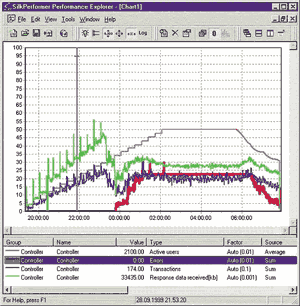
Java developers have found that a good testing tool is essential for building a high-quality application; such tools are a must to meet schedule and performance requirements of Java systems
While providing savings in IT staff and equipment and letting you focus on your core business, ASPs do present real risks that must not be overlooked.
'Pure-play' Internet retailers are adding offline operations to gain the trust of shoppers wary of online businesses; at the same time, 'brick-and-mortar' operations move to more closely link online and offline efforts.
Portals can give a single access point to corporate data, but not until a framework and structure are built to better organize and secure complex information.
As Microsoft integrates MTS into Windows, irritating limitations are eliminated, while performance and scalability are improved; Windows 2000 becomes strong e-business platform contender.

Testing and monitoring can help your company build apps to handle the loads of e-business traffic. High-flying sites that ignore these factors can quickly be brought back to earth.